
¿QUÉ ESTÁS BUSCANDO?
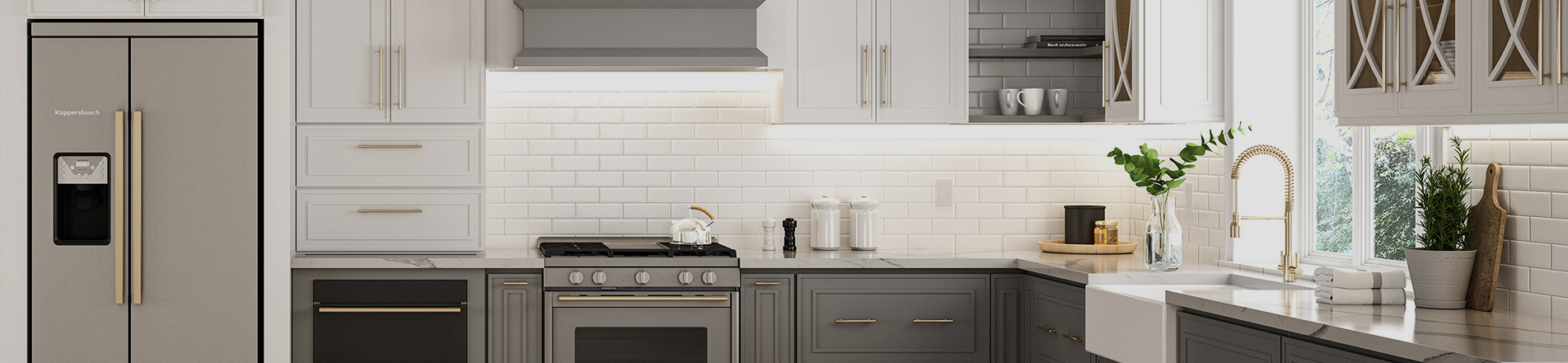
RTA cabinets are not made from one single material. “RTA” simply means Ready-to-Assemble. They are generally sold in flat-pack form. The materials for self-assembled cabinets can be solid wood or engineered wood. Different material options determine the overall price and performance of RTA cabinets, so careful selection is required to get cabinets that meet your expectations.
Modern RTA cabinets offer a wide range of options. Cabinet boxes, doors, shelves and drawer boxes can each use different materials. Every material has its own strengths and suitable applications based on positioning. As a Vietnamese cabinet wholesaler, our default configuration for RTA cabinets is as follows: cabinet boxes and shelves are plywood; cabinet doors feature solid wood frames paired with MDF center panels, or full MDF slab doors by default; drawer boxes are solid wood with dovetail joinery. Custom options for other wood species are also available.
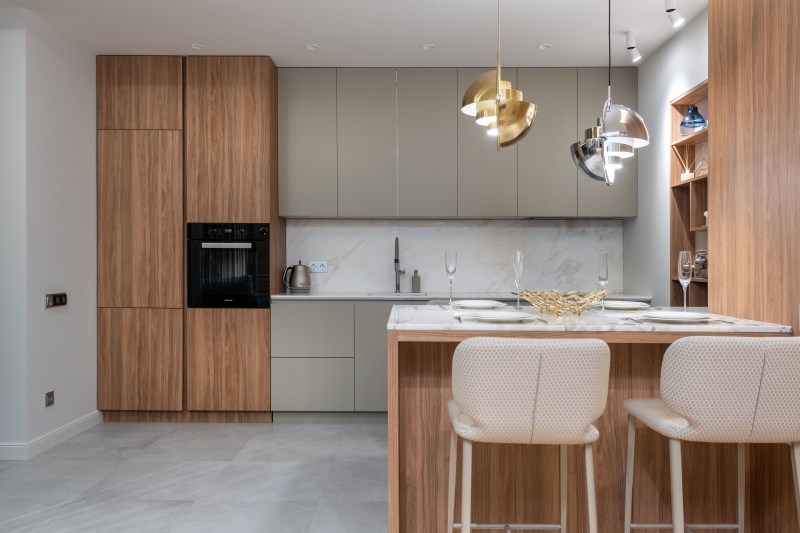
What Exactly Are RTA Cabinets?
Understanding the basic definition of RTA cabinets is essential to grasp their material selection logic. RTA stands for Ready-to-Assemble, also known as quick-assembly cabinets or prefabricated cabinets. Unlike fully assembled cabinets, all panels are pre-machined by CNC equipment at the factory: side panels, bottom panels, top panels, back panels, door panels, drawer fronts and drawer boxes, shelves, and toe kicks are manufactured to standard dimensions. They are packed together with hardware and connectors for shipment. Instead of being fully assembled at the factory, they need to be assembled on-site by yourself or professional installers.
Key features compared with traditional finished cabinets and custom cabinetry:
1. Components as finished products: The factory only produces standardized panels and hardware, without pre-building complete cabinets. The compact packaging reduces shipping volume, simplifies transportation and lowers the risk of damage during transit.
2. On-site assembly: All panels, screws, hinges and installation manuals are included. Cabinets can be assembled on-site following drawings, with no need for on-site cutting or trimming.
3. Standardized sizing: Cabinet dimensions and pre-drilled holes follow unified standards, enabling fast lead times and more competitive pricing. While less flexible in custom sizing than fully custom cabinetry, they cost substantially less, making them ideal for budget-conscious projects.
4. Great for renovations: Vietnamese-manufactured RTA kitchen cabinets are easy to disassemble and reassemble, which works perfectly for home remodels or kitchen upgrades in rental properties and shortens renovation timelines.
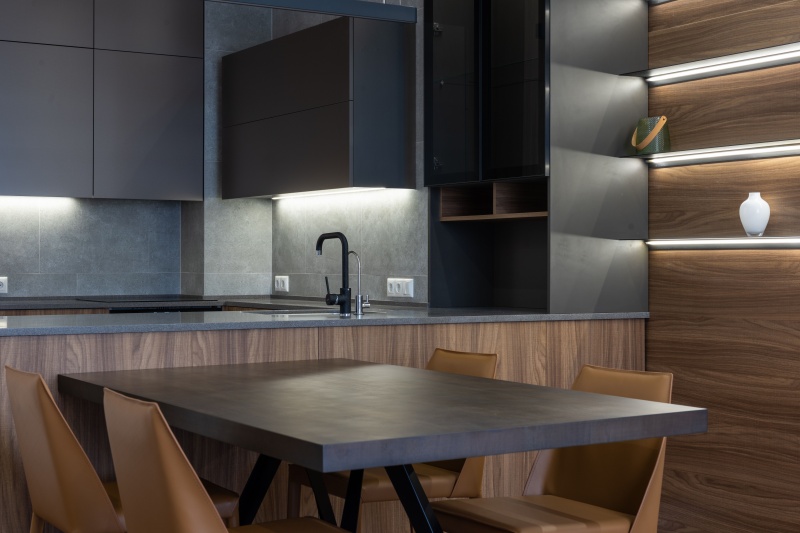
Breakdown of RTA Cabinet Structure
To understand what RTA cabinets are made of, we first clarify each component before reviewing its typical materials. Even a basic base cabinet uses two or more panel types. Therefore, you cannot assume a cabinet is built entirely of plywood just because it is labeled “high-quality plywood American standard kitchen cabinets” — this would be incomplete information from an engineering perspective.
| Component | Function | Common Material Options | Positioning Notes |
| Cabinet Side Panels | Vertical load-bearing; mounting point for hinges, slides and hanging brackets | Birch plywood / Poplar plywood / Melamine particleboard / MDF | Superior screw holding power, better moisture resistance and low expansion rate |
| Cabinet Bottom Panels | Supports shelves and full drawer loads, bears concentrated point loads | Same substrate as side panels, usually a higher grade | Resists deflection under load; edge sealing quality matters for exposed kick space panels |
| Top Panels / Hanging Rails | Transfers load from hanging brackets to side panels; the primary load-bearing part for wall cabinets | Plywood or particleboard, 1/2–5/8 inch thickness | Critical pull-out resistance for wall-mount screws |
| Back Panels | Maintains cabinet lateral rigidity and squareness, seals gaps against walls | Plywood / MDF / Particleboard | Blocks moisture and dust from walls |
| Adjustable Shelves | Removable, span 24–30 inches with minimal sagging | Plywood or particleboard with finished edge banding; steel clips for commercial-grade units | Long-term load capacity, anti-sag and weight-bearing performance are priorities |
| Door Center Panels / Door Frames | Exposed finish surface, subject to ongoing temperature and humidity fluctuations | Solid wood frame + MDF center panel / Melamine MDF / Thermofoil MDF / Solid wood / Full MDF | Flatness, paint adhesion and long-term warp resistance |
| Drawer Boxes | Supports slides and heavy tableware | 5/8-inch dovetail solid wood / Plywood / Melamine particleboard | Dovetail joint strength, budget options for undermount slides |
| Face Frame (Optional) | Structural reinforcement at the front of American framed cabinetry | Rubberwood / Birch | Boosts overall cabinet rigidity |
Guide to Common Materials for RTA Cabinets
1. Plywood
Plywood is the preferred substrate for cabinet boxes of high-end residential and commercial RTA cabinets. It is made by gluing thin wood veneers stacked in alternating grain directions under heat and pressure. Birch, poplar and oak veneer plywood are widely used for RTA cabinets, with common cabinet thicknesses of 1/2 inch and 3/4 inch.
Advantages
Disadvantages
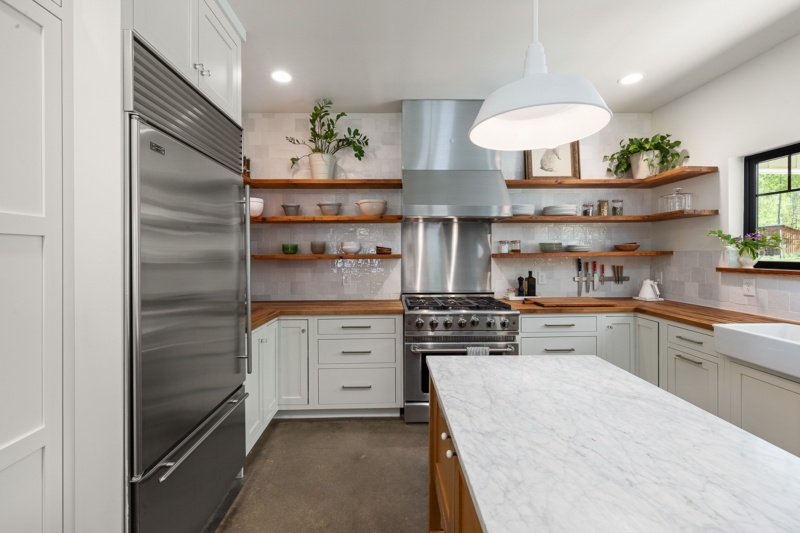
2. MDF
MDF (Medium-Density Fiberboard) is manufactured by compressing fine wood fibers mixed with resin into uniform, consistent panels. It delivers higher density and smoother surfaces than particleboard and plywood. Full MDF cabinet boxes are rare in premium RTA cabinet lines, yet MDF is extremely common for intricate carved doors and recessed center panels of inset cabinet doors.
Advantages
Disadvantages
3. Particleboard
Particleboard is the most common substrate for entry-level, budget-friendly RTA cabinet boxes. It is formed by compressing wood chips and shavings mixed with resin under high heat and pressure. Nearly all particleboard RTA cabinet boxes are laminated with melamine-impregnated paper on both sides, with exposed edges sealed with edge banding to block moisture ingress.
Advantages
Disadvantages
4. Solid Wood
Are RTA cabinets all solid wood? Based on 2026 industry standards, solid wood is only used selectively. Fully assembled RTA cabinet boxes rarely use solid wood panels:
Surface Finish Overview: Stain, UV Coating, Melamine, Thermofoil
The visible outer finish is a separate engineering system from the substrate. RTA cabinets consist not only of wood substrates but also eco-friendly coatings for surface finishing. The four mainstream finishing processes for RTA cabinets are listed below:
1. Veneer Staining
Oak, maple or walnut veneer is bonded to MDF or plywood door panels before staining. This process creates shades difficult to achieve with natural solid wood, or replicates natural wood tones. Maple can be stained to mimic cherry, delivering highly realistic wood grain stained RTA kitchen cabinets and a high-end custom look at lower cost.
2. UV-Cured Coating
Multiple layers of acrylic coating are sprayed and cured under ultraviolet light in a UV tunnel. The resulting hard finish resists yellowing, features low VOC levels, and consistently achieves the popular matte inset door look. This is a widely adopted process at Vietnamese RTA kitchen cabinet factories.
3. Melamine
Melamine-impregnated paper is thermally pressed onto particleboard or plywood. Almost all economy-grade RTA cabinet interiors use this finish, available in solid colors, wood grains, matte and textured options. It is scratch-resistant, stain-resistant and easy to clean. Deep scratches will expose the raw substrate and cannot be repaired.
4. Thermofoil
Flexible PVC or acrylic film is vacuum-formed over MDF door panels. It is widely used for slab doors and curved profile doors. The fully wrapped finish creates uniform matte or gloss surfaces with no exposed edges and no touch-up painting required. It is easy to wipe clean and cost-effective for carved and slab doors, yet repairs are difficult once damaged.
Summary
Material selection for RTA cabinets is not simply a question of “whether it is real wood”. It is a layered engineering decision: which substrate carries loads, which finish withstands humidity, which edge banding seals porous panels, which connectors suit on-site assembly, and which hardware stands up to daily opening and closing.
A properly engineered RTA cabinet system follows these rules: plywood for high-load components; particleboard where flatness and budget are priorities; MDF for painted exposed doors; solid wood for wear-prone frames and visible structural parts. Every cut panel comes with compliant environmental certifications and reliable edge sealing. When these requirements are met, RTA cabinets deliver durability comparable to many site-assembled cabinets while cutting freight and on-site labor costs — an advantage hard for local custom cabinet shops to match.
Union Woods is a Vietnamese RTA cabinet manufacturer focused primarily on the US market. Our facility spans 300,000 square feet with fully automatic CNC production lines. We hold full certifications including ISO9001, FSC, CARB P2, E0 and CE. Our minimum order quantity is one 40HQ container. If you are bidding on multi-family, hotel, rental renovation or coastal projects and require itemized material quotes instead of vague showroom pricing, our engineering team can walk general contractors through substrate, edge banding, hardware and connector selection line by line.


 Hoja informativa
 English

 IPv6 RED SOPORTADA